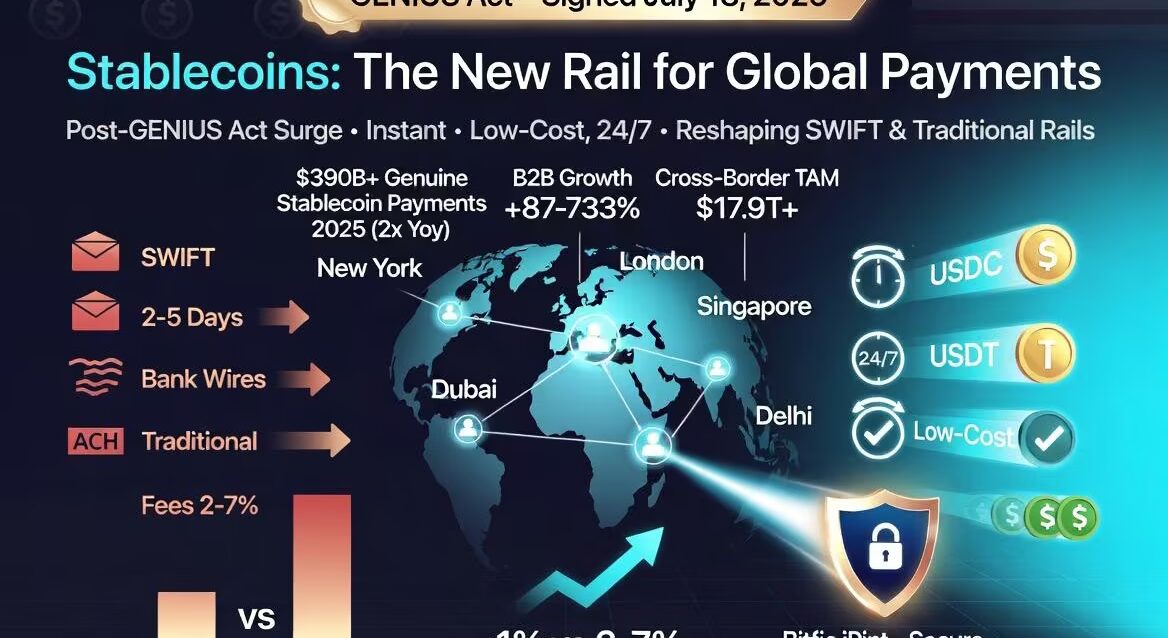
Cross-border payments have long been plagued by high costs, slow settlement times, opacity, and reliance on correspondent banking networks. Traditional rails like SWIFT and systems such as ACH dominate, but they often take days to settle, incur fees of 2-7% or more, and operate only during banking hours. Enter stablecoin rails—blockchain based transfers using dollar-pegged assets like USDC and USDT—which offer near-instant, 24/7 settlement at fractions of the cost. Over the last year (roughly April 2025 to April 2026), and especially following the U.S. GENIUS Act signed in July 2025, stablecoins have transitioned from niche experiments to a meaningful disruptor, capturing explosive growth in genuine payment volumes while traditional systems maintain scale but face competitive pressure.
The GENIUS Act: A Regulatory Catalyst signed July 18, 2025
On July 18, 2025, President Donald J. Trump signed the Guiding and Establishing National Innovation for U.S. Stablecoins Act (GENIUS Act, Public Law 119-27) into law. This landmark bipartisan legislation created the first comprehensive federal framework for payment stablecoins, requiring 100% reserve backing with high-quality assets (e.g., USD deposits, short-term U.S. Treasuries, or Fed balances), monthly disclosures, AML/KYC compliance, and technological capabilities for seizure/freeze/burn when legally required. It authorizes both bank and nonbank issuers under federal or qualifying state oversight, with size-based thresholds, while imposing strict rules on foreign issuers offering stablecoins in the U.S.
The Act’s clarity eliminated regulatory uncertainty, boosting issuer confidence and institutional adoption. It positioned the U.S. as a leader in digital assets, with provisions for interoperability and reciprocal international agreements. Post-enactment, stablecoin payment activity accelerated sharply: genuine (non-trading, non-automated) flows for goods, services, and transfers surged 70% in the months following, reaching over $10 billion monthly by August 2025—more than double the prior year’s comparable period and up from $6 billion in February.
Real Data: Stablecoin Growth vs. Traditional Rails (2025–2026)
Stablecoin adoption has been dramatic. Total reported transaction volume exceeded $33 trillion in 2025 (up ~72–105% YoY depending on adjusted metrics), with adjusted transfer volume hitting $11.6 trillion (90% growth). While much of this includes liquidity and trading, genuine payment activity reached $390 billion in 2025—more than double 2024 levels—according to McKinsey and Artemis Analytics. B2B payments accounted for ~60% ($226 billion in some estimates, or $83.1 billion per Allium data, up 87–733% YoY in segments), driven by payroll, supply-chain settlements, and invoices. Small-value transactions ($1–$10,000) grew tenfold, signalling real commerce use.
Cross-border remains the sweet spot: stablecoins target a $17.9 trillion+ total addressable market in non-G20 corridors, where traditional infrastructure is weakest. By early 2026, Visa’s stablecoin settlement program achieved a $4.5 billion annualized run rate, while Revolut processed over $1.2 billion in stablecoin transfers on Polygon alone. Asian corridors (Singapore, Hong Kong, Japan) led, comprising ~60% of global stablecoin payment volume.
In contrast, traditional rails show steady but slower growth without the same velocity:
• SWIFT: Handled record traffic in 2025 with double-digit growth and over 68 million messages in a single day. SWIFT gpi processed 85 million cross-border payments, with 63% credited to beneficiaries within 30 minutes (an improvement, but still not instant). SWIFT remains the backbone for high-value wholesale flows, yet its correspondent model incurs higher costs and delays compared to blockchain rails.
• ACH (and international variants): Primarily U.S.-domestic, the ACH Network processed 35.2 billion payments worth $93 trillion in 2025 (up ~5% volume and ~8% value YoY). B2B ACH grew nearly 10% to 8.1 billion transactions, and Same Day ACH hit 1.4 billion payments ($3.9 trillion, up 16.7–21.4%). While efficient for domestic U.S. flows, international ACH is limited in scope and speed versus global stablecoin rails.
Overall cross-border payments market value exceeded $194 trillion (2024–2025 baseline), projected to grow significantly, but stablecoins still represent under 1% of total volume—yet their growth trajectory (e.g., B2B surges post-GENIUS) indicates rapid market share gains in high-friction corridors like remittances and emerging-market B2B.
Stablecoins deliver measurable advantages: settlement in minutes (vs. days for SWIFT wires), fees often around 1% or lower, 24/7 availability, and programmable features. This has enabled hybrid models where stablecoins act as a “bridge” for instant on-chain movement before fiat off-ramps, reducing pre-funding needs and FX friction.
Top Global Providers Embracing Stablecoin Rails
Major players have moved aggressively post-GENIUS Act, integrating or acquiring stablecoin capabilities to future-proof offerings:
- Stripe: Acquired Bridge (stablecoin infrastructure) for $1.1 billion in late 2024; rolled out stablecoin acceptance for merchants in 100+ countries in 2025, enabling direct wallet settlements and cross-border payouts. Plans emphasize seamless fiat-to-stablecoin conversion for global commerce.
- Visa: Launched tokenized asset and stablecoin settlement programs; hit $4.5 billion annualized run rate by January 2026. Partnered with BVNK and Triple-A for payout rails and card-linked USDC spending. Focus: institutional B2B and consumer spend without conversion friction.
- Mastercard: Acquired BVNK (up to $1.8 billion) for enterprise stablecoin infrastructure; integrated with remittance-as-a-service providers. Strategy: hybrid fiat-blockchain rails for B2B and remittances.
- PayPal, Revolut, and Others: PayPal expanded stablecoin support for transactions. Revolut routed $1.2 billion+ on Polygon. Fintechs like Nium launched stablecoin-funded Visa/Mastercard cards for cross-border use.
These providers view stablecoins as complementary—enhancing rather than replacing legacy systems—for faster, cheaper flows while maintaining compliance.
Key Infrastructure Providers Powering the Rails
Behind the scenes, specialized firms supply the plumbing:
- Circle (USDC issuer): Operates the Circle Payments Network (CPN) for compliant, near-instant institutional settlement using USDC/EURC. Focus: financial institutions and enterprises.
- Tether (USDT): Dominant by volume; powers high-liquidity retail and emerging-market flows.
- BVNK, Bridge (now Stripe), Triple-A: Enterprise-focused for B2B payouts, treasury, and hybrid fiat-stablecoin conversion; BVNK processes billions annually.
- Fireblocks: Institutional custody and settlement infrastructure, enabling secure multi-chain transfers for banks and fintechs.
Emerging players are also scaling rapidly.
Bitfia: Emerging as a Secure, Top Institutional Provider
Amid this shift, Bitfia stands out as a forward-looking institutional-grade provider redefining cross-border rails through its iPint platform. Leveraging USDT and stablecoin infrastructure, iPint delivers seamless, compliant, blockchain-powered transfers for B2B remittances, supply-chain settlements, and cross-border payroll—eliminating intermediaries, conversion delays, and volatility while maintaining fiat-like certainty.
Bitfia’s “Security First” DNA—rooted in enterprise-grade protocols, non-custodial wallet heritage, encryption, private-key management, and multi-standard support (ERC20, TRC20, BEP20)—prioritizes transaction integrity and institutional trust. It bridges TradFi and decentralized networks with proactive regulatory alignment, enabling borderless liquidity and instant finality beyond T+2. Recognized on the Forbes DGEMS 2025 “Select 200” list for its impact on global fintech and architecting the future of payments, Bitfia is accelerating mass adoption by upgrading (not replacing) current infrastructure.
With iPint already live for instant USDT-based commerce and the high-throughput Pint Blockchain in development (for DeFi bridging, tokenization, and energy-efficient high-TPS settlements), Bitfia is positioned as a secure, scalable leader for enterprises seeking compliant stablecoin rails in a post-GENIUS world.
Outlook: A Hybrid Future
Stablecoins will not fully displace SWIFT or ACH overnight—their scale remains unmatched for certain high-value flows—but they are carving out significant share in speed-sensitive, cost-sensitive corridors. Post-GENIUS clarity has supercharged institutional confidence, with 2025–2026 data showing payments volumes doubling or more while traditional rails grow modestly. As providers like Stripe, Visa, and innovators like Bitfia scale infrastructure, expect hybrid models to dominate: stablecoins for the “middle mile” of instant movement, traditional rails for final fiat on/off-ramps. The result? Faster, cheaper, more inclusive global payments—benefiting businesses, remittances, and economies worldwide. The GENIUS Act didn’t just regulate stablecoins; it unlocked their potential as the next infrastructure layer for cross-border finance.